The emergency phase of the warehouse fire is over, but the environmental assessment phase is just beginning. This article covers what Tracy, CA, residents should know and do to stay safe after the Medline fire.
Key Takeaways: What to Do (and not Do) If You Live or Work Near the Medline Warehouse
| DO | DON’T |
|---|---|
| Report debris using San Joaquin County’s online reporting system or call Clean Harbors at 209-751-1888 for free debris cleanup on your property. | Touch debris on your own unless absolutely necessary; if you do, wear gloves and an N95 mask. |
| Make sure your home is thoroughly tested; if possible, leave your home until it’s confirmed safe. | Assume no odor means your home is safe. Testing is the only way to know. |
| Push for independent testing from a company that prioritizes your safety over your insurer’s profits. | Default to your insurer’s preferred vendors, who often downplay the seriousness of post-fire contamination. |
What Was the Medline Medical Warehouse Fire?
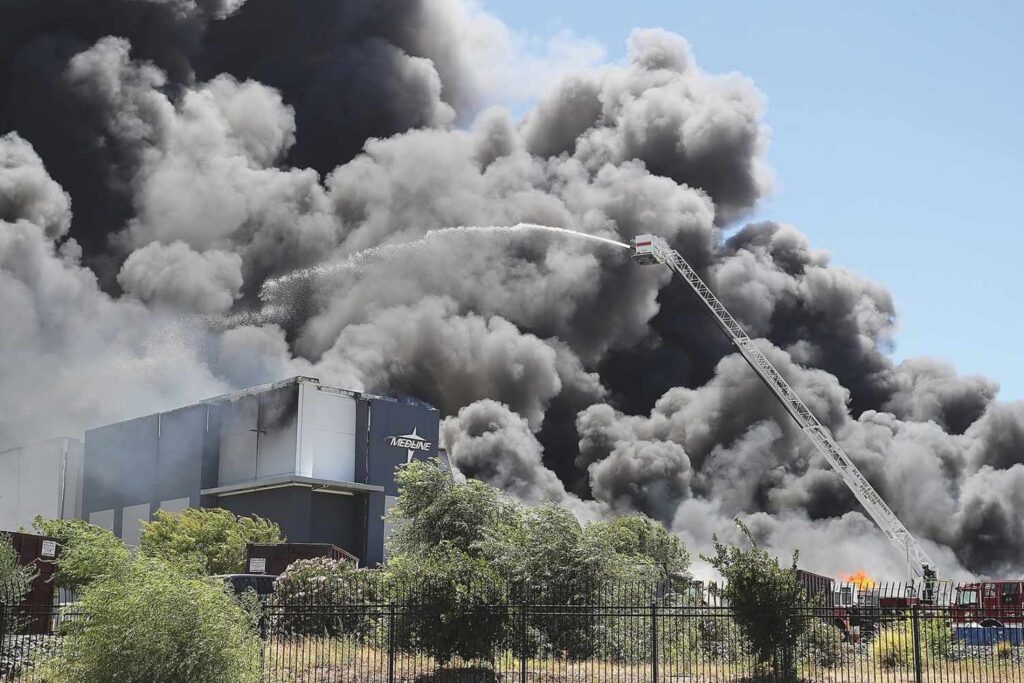
On June 11, 2026, a fire broke out at Medline’s roughly one-million-square-foot medical distribution warehouse in Tracy, California. The facility was completely destroyed, making it one of the largest warehouse fires of its kind in U.S. history.
The size of the fire – combined with sprinkler systems that didn’t activate and a lack of water pressure from nearby fire hydrants – made it nearly impossible to extinguish. Firefighters used over a million gallons of water to douse the flames as much as they could before stopping to let it burn out on its own. That meant more smoke in the air, for a longer period of time.
The fire burned for several days.
What Burned and Why It Matters
Medline’s facility reportedly contained medical products, plastics, packaging materials, bleach, sulfuric acid, and xylene. It also housed 174 robots powered by lithium-ion batteries, all of which burned.
As they burn, these products can release:
- Hydrogen fluoride gas (from burning lithium batteries)
- Respiratory irritants
- Heavy metals
- Carcinogens
- Toxic gases & neurotoxins
Residents were told there was “no real concern for the public,” and in the same breath told to keep children and immunocompromised individuals indoors.
What Did the Air Quality Data Show?
Air quality sensors in the area didn’t register readings worse than “moderate” during the fire, which sounded reassuring. However, that data only accounts for how much particulate matter is in the air, not what’s in the particulate matter.
For example, no level of lithium exposure is safe, yet no air quality index reading tells you whether you’ve been exposed to it. A “moderate” reading during an industrial fire of this magnitude does not mean the air was safe.
Where Did the Smoke and Debris Go?
The fire produced massive smoke plumes that traveled across nearby neighborhoods, covering nearby schools and homes and entering through crawl spaces, attic vents, doors, windows, and even small nail holes, which act like vacuums, pulling smoke in and spreading it throughout the home.
Residents reported finding a black, foam-like material on sidewalks and in yards and debris in parks, on trails, and on roadways throughout the area.
The smoke also traveled to nearby commercial facilities – including FedEx, Amazon, and Safeway distribution centers – that continued operating during and after the fire event.
Fine particles and combustion byproducts can settle on roofs, HVAC systems, playgrounds, vehicles, outdoor furniture, and inside dust reservoirs. The San Joaquin Valley Air District reported elevated PM2.5 levels in areas near and downwind of the fire during the event.
What Homeowners Should Do
Just because your home is still standing, don’t assume it’s safe. Carcinogens can remain in your home long after the fire is out and the smoke plume fades.
Here’s what you should do:
- Have your home tested for post-fire and smoke particulates. Find an independent testing company who puts your health and best interests above your insurer’s profits.
- If you find ash or debris on your property, don’t touch it. Report it here or call 209-751-1888 to have it professionally removed.
- Take pictures of any smoke damage or debris for future insurance claims or class-action litigation documentation.
- If you’re a parent, ask your child’s school or childcare facilities what steps they took after the fire. (See more below.)
Clean Harbors, Medline’s third-party environmental response company, released a statement stating the debris is non-hazardous. That claim deserves scrutiny. Because the debris came from multiple sources – and contaminants can contain heavy metals and plastic byproducts – don’t assume it’s safe.
What Workers in Nearby Warehouses Should Do
You spend 40+ hours a week in your workplace. You deserve to know it’s safe.
Here’s what you should do:
- Ask whether your employer conducted any assessment of air quality post-fire.
- If so, ask to see the results.
- If not, ask why – and request proof your workplace’s indoor air is safe.
- Ask whether the HVAC systems have been thoroughly cleaned post-fire.
What Parents and School Officials Should Do
Children are generally more vulnerable to airborne contaminants because their lungs are still developing and they breathe more air relative to their body weight. That’s not a reason to panic, but it is a reason to ask the right questions.
If your child’s school or childcare facility is near the Medline site, here’s what to ask:
- Were campuses exposed to smoke while students or staff were present?
- Were outdoor activities restricted during and after the smoke event?
- Was an assessment conducted for ash or debris on school grounds or playgrounds?
- Were HVAC systems inspected and cleaned after the fire?
- Was the property’s indoor air quality tested? Can I see the results?
Schools and childcare facilities in affected areas should conduct environmental assessments. If yours hasn’t, it’s worth asking why.
Concerned about your Tracy, CA, home or business? We’re here to help.
The emergency response phase is over, but for residents near the Medline site, the environmental assessment phase is just beginning. You have the right to know what was released, where it went, and whether any of it is still in your home or workplace. Push for independent testing, and don’t accept reassurances at face value just because the visible smoke is gone.
M.A.R.S. Environmental provides independent post-fire indoor air quality testing for homeowners, businesses, and schools. We work for you, not your insurance company. Contact us here or call 720-388-8448 to discuss testing for your property.