Before it was widely known to cause lung scarring and mesothelioma, asbestos was incorporated into all sorts of materials within a home. Indoor air quality expert Jeanine Humphrey discusses the best practices for residential asbestos testing and details your options for dealing with confirmed asbestos-containing material.
Nearly all the great crooners of the 40s and 50s at some point sang the line “Heaven rest us, I’m not asbestos!” (implying that their hearts could be easily set ablaze). Dorothy Fields wasn’t thinking of health hazards when she wrote the lyrics to “I Won’t Dance”; she just knew asbestos was a great fire retardant.
Unfortunately, for homes built before 1978, a lot of stuff inside probably is asbestos, in large part because it’s such a great fire retardant.
It’s quite the conundrum for millions of homeowners today, particularly those looking to sell or remodel.
Here, we’ll take a look at where you’re likely to find asbestos, how you can test for it, and what your options are for asbestos management.
How asbestos fibers impact your health
Asbestos risks started being observed among people working in factories in the 1920s, but it wasn’t until the 1960s that researchers began solidifying the link between asbestos and dangerous lung conditions like mesothelioma—even for people who were simply living in asbestos-containing structures.
When disturbed, microscopic fibers can become airborne. When you inhale them, they act like tiny daggers stabbing into your lung tissue, causing inflammation that last for decades. Over time, this inflammation can lead to cancer, often many, many decades post-exposure.
In many cases, asbestos is locked inside wall materials or otherwise sealed away in parts of the home. When it’s undisturbed and in good condition, it generally doesn’t pose a health risk.
Over time, however, asbestos-containing materials can break down, and that’s when there’s cause for concern. Home renovations supercharge this process, sometimes releasing huge amounts of the fibers into a living space.
Damage from natural disasters like fires and floods are also likely to turn once-stable asbestos into a health hazard.
Where does asbestos usually show up in a home?
The short answer is pretty much everywhere. Anything that’s not made out of wood, glass, or metal has the possibility of containing asbestos.
The more detailed—but not exhaustive—answer is:
- Surfacing materials on walls or ceilings, particularly anything that’s spray- or trowel-applied
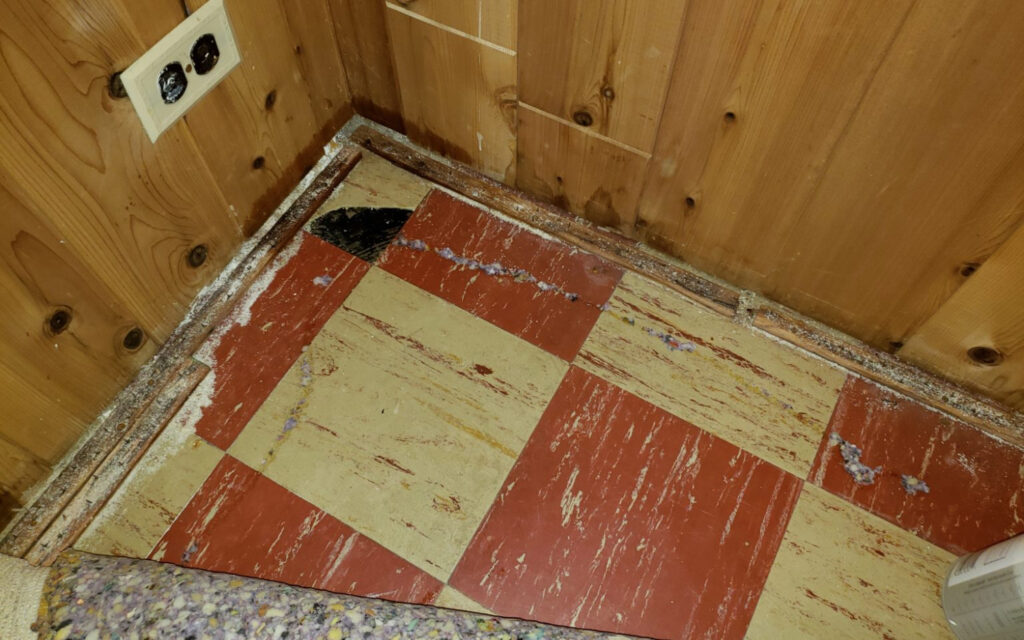
- Flooring, particularly in 9×9 and 12×12 vinyl tiles and in mastic adhe sive
- Attic and wall insulation made out of vermiculite
- Window glazing and caulking materials
- Piping, roofing, and siding made out of older transite, which originally mixed cement with asbestos (newer transite uses crystalline silica in place of asbestos)
- Joint compound for finishing and repairing drywall
- TSI (“thermal system insulation”) materials used for duct wrapping
By all measures (aside from health), asbestos was a phenomenally good product. It helped stabilize materials like caulk and insulation and made them more water- and heat-resistant. It was even used to make fake snow for Christmas trees.
Friable vs. non-friable asbestos
There are two main categories of asbestos-containing materials: friable and non-friable. These have varying implications for health, safety, and testing.
- Friable asbestos is anything containing more than 1% asbestos that can be crumbled or crushed by hand into a powder when it’s dry. Examples include thermal insulation, spray-on paints, and popcorn ceilings.
- Non-friable asbestos is the opposite—it can’t be crumbled with hand pressure. It includes vinyl floor tiles, home siding, and cement sheets.
Since friable asbestos breaks apart easily, it’s more likely to release fibers into the air, endangering your health. But this doesn’t mean that non-friable asbestos is entirely safe. The health risks of the latter typically arise when someone remodels a part of the home that contains these materials.
For testing, it’s easier to collect samples of non-friable asbestos, since it won’t shed as many fibers. Any attempt at collecting a sample of friable asbestos runs the risk of sending its particles airborne.
Reasons to suspect you’ve got asbestos—and why you shouldn’t DIY its removal
People often wonder if they can tell that something is asbestos just by looking at it. Unfortunately, there aren’t any visual cues that asbestos is present in a material. The hazardous fibers themselves are microscopic and can only be confirmed through laboratory testing.
The best way to know if your home contains asbestos is to find out when it was built. If it’s from 1978 or earlier, it probably has some.
Even after 1978, asbestos could still make its way into homes, because it wasn’t banned everywhere across the globe. And the United States didn’t ban one type—chrysotile asbestos—until March 2024.
If you think there’s asbestos in your home, the worst thing you could do is to try to remove it yourself. This is bad for two reasons:
- It’s dangerous.
As we mentioned above, disturbing asbestos—particularly friable asbestos—has the potential to release the tiny, lung-scarring fibers into the air, where you might breathe them in. - It becomes regulated once you remove it.
As soon as you start taking out asbestos-containing material, you’re responsible for disposing of it properly. Most DIYers aren’t prepared to do this.
Hiring unqualified contractors to work on a part of your home that has asbestos is also risky. Many homeowners will hire painters that aren’t qualified and ask them to scrape a popcorn ceiling … and then they’ve got a major spill on their hands.
Once asbestos is confirmed, what are your options?
There are really just three options for dealing with asbestos:
- leaving it alone
- enclosing it
- removing it
Homeowners whose asbestos is in good condition, and who don’t plan on doing any remodeling projects that would disturb it, may opt for simply letting it be. If the building materials suspected of containing asbestos aren’t damaged, then the risk of the fibers being released into the air is low (at least for the time being).
If the asbestos-containing material is damaged but removal is unrealistic, you can choose to have it enclosed. For example, if you have a popcorn ceiling, you can put a sticker on it saying it’s an asbestos-containing hazard, and then you can put drywall over it. You’ll have to disclose this when you sell your home.
In some cases, you can encapsulate asbestos, or seal it in place. This only works if it isn’t friable. The material will be coated with a substance that binds the asbestos fibers, creating a layer of protection over it. Keep in mind that this coating will degrade with time.
Finally, you may elect to have the asbestos removed. Asbestos abatement in Colorado is heavily regulated through the CDPHE (Colorado Department of Public Health & Environment), and this includes certification requirements for contractors. Anyone removing asbestos in the state is required to have a full containment setup with a negative air pressure system. (The only state that’s stricter about asbestos than Colorado is New York.)
Regulations covering asbestos abatement in Nebraska lean more heavily on federal NESHAP (National Emission Standards for Hazardous Air Pollutants) standards without as much state-specific oversight. If you have less than 160 square feet of material being removed in your Nebraska home, you don’t have to do anything unless it’s a property with more than four units. You’re not even required to wear a mask or have a containment set up if it’s a nonfriable material.
This being said, it’s always good to prioritize your health, even when regulations don’t enforce such precaution.
How asbestos testing works, and why point count analysis might save you money
The standard method for testing building materials for asbestos content is polarized light microscopy (PLM). Asbestos fibers refract light in a distinct manner, and PLM can detect their presence by analyzing this optical signature.
If the test results of a bulk sample indicate asbestos content of 9% or less, you might want to do a point count analysis. This is a more accurate measure that can verify whether the true concentration of asbestos is less than 1%—which, in the eyes of the Occupational Safety and Health Administration (OSHA), qualifies as a “non-asbestos-containing material.”
M.A.R.S. Environmental has seen clients save $15,000 on a project thanks to point count testing.
Do you need to hire qualified inspectors for testing, or can you test for asbestos on your own? The EPA (Environmental Protection Agency) doesn’t recommend doing it yourself. If you sample the material incorrectly, you’re likely to release more fibers into the air.
Gauging the risks and making a plan
In a lot of cases, you can feel OK about leaving the asbestos where it is and carrying on with your life. As long as it’s not deteriorating, and you don’t have any plans to remodel the area of the house where it’s located, leaving it alone can be the best option.
If you’re planning to do some work in a possible asbestos-containing area, then you’ll want to know what you’re dealing with. Testing can help you determine whether you should engage the services of an asbestos abatement company to avoid a major spill.
Remember—it’s about your health over the long term. Flouting the safety precautions and going ahead with DIY asbestos removal may seem convenient in the moment, but it’s not worth the risks to you and your family decades into the future.
Wondering if your home contains asbestos? Get safe, accurate testing from M.A.R.S. Environmental before going ahead with a remodel or other household project.