
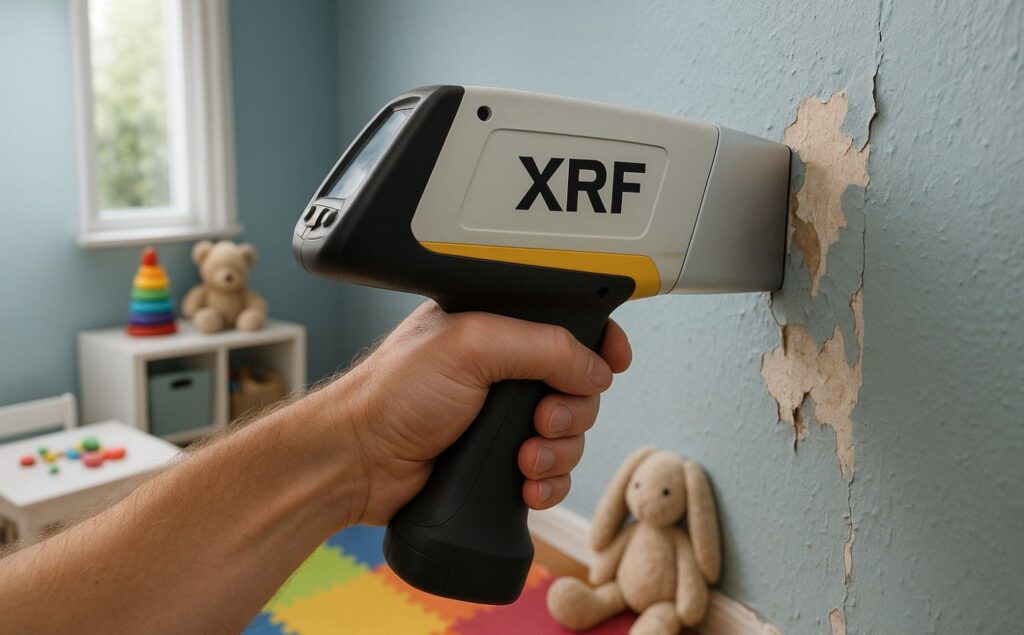
Before it was banned in 1978, lead-based paint was widely used inside Colorado and Nebraska homes. Find out how to test your home for lead—and what your remediation options are—from indoor air quality expert Jeanine Humphrey.
Unlike microplastics, volatile organic compounds (VOCs), and other potentially harmful materials of the modern era, the health risks of lead have been well known for centuries. For millennia, even.
Despite this knowledge, the heavy metal was used for decades in the paint covering the walls of people’s homes. Lead improves moisture resistance, drying time, and durability. In some cases, its compounds are responsible for the paint’s color.
Perhaps it seemed safe so long as the paint remained stuck to the walls, undisturbed in perpetuity. But that’s not how it works. Paint flakes off and turns to dust, children scratch at it and lick it, and the lead compounds gradually spread throughout the whole home environment.
The residential use of lead-based paint was banned in 1978, so one of the biggest indicators that your home might have a lead problem is its age. In Colorado, nearly 11% of the housing stock potentially have an elevated lead risk, according to America’s Health Rankings. The estimated need for lead paint remediation in Nebraska is almost twice as high, sitting at 20.5%.
Why is lead so bad for your health?
Lead harms the human body in a number of ways. It can increase blood pressure, cause memory problems, and lower fertility, among other things.
It’s particularly dangerous for children, whose bones are growing rapidly. When blood lead levels are high, the body mistakenly stores its atoms in our bones in place of calcium, stunting growth. The brain also absorbs lead at high rates, leading to learning difficulties.
In extreme cases, people with lead poisoning can suffer from seizures, brain swelling, and kidney failure.
Is it just the paint, or are there other sources of lead exposure in older homes?
It’s not just the paint. Lead is part of our environment. Since it’s naturally present in the soil, kids and dogs can bring it inside.
If you’re not cleaning your home regularly, the lead dust from degraded paint and the lead that’s being tracked in from the outdoors can build up.
It can also be in the plumbing. Thankfully, the majority of this plumbing no longer exists, but some of the Denver areas are still switching out some piping.
What does a lead inspection entail?
Unlike some types of hazardous building materials inspections—such as meth residue testing, which uses an alcohol-based product that can damage paint—lead testing won’t harm your home’s surfaces.
Lead-based paint testing companies use X-ray fluorescence (XRF) to check for the presence of the heavy metal in painted surfaces. A quick overview of how this industry-standard method works:
- The inspector uses a handheld device to direct a beam of X-rays at a painted area.
- The X-ray beam excites electrons within lead atoms, jolting them into a higher energy level.
- Other electrons drop into the (recently vacated) lower energy levels, emitting their own X-rays at a specific energy.
- These X-rays can be measured, showing that lead atoms are present.
It’s quick—under 10 seconds per testing spot—and easy, but it should be done by someone who is certified by the state or the Environmental Protection Agency (EPA). This ensures that you’re getting the right data.
M.A.R.S. Environmental can also take paint chip samples. If your property is a multi-family unit, OSHA (the Occupational Safety and Health Administration) requires paint chip samples along with XRF testing.
We test every painted surface in a room, as well as all door and window components. Previous lead remediation efforts may have only dealt with vertical heights up to five feet (since most children are shorter than that), so we make sure to test above that height.
The difference between a lead inspection and a lead risk assessment
It’s one thing to determine where lead may be present, and another to evaluate its hazards and the means of mitigating them.
Lead might be present in equal quantities in two different painted areas, but if one is flaking off and the other is not, the health risks are quite different. This is why inspections and risk assessments are separate things.
- A lead inspection, as described above, uses XRF testing and possible paint chip sampling to find places that contain lead-based paint and identify its type.
- A lead risk assessment identifies the actual hazards of lead-based paint based on its condition (is it intact or deteriorating, how much lead dust is it creating, etc.). M.A.R.S. Environmental will also fill up bathtubs with water, drain them, and do a dust wipe.
To conclude the risk assessment, M.A.R.S. Environmental writes up protocols on how to remediate the hazards, stabilize the paint, and meet the appropriate dust-lead clearance levels.
The EPA’s new rule on lead testing safe levels
There really isn’t any safe level for lead dust—an understanding that’s reflected in the newly tightened EPA standards for lead.
Of course, for the purpose of clearances, getting levels down to zero can be unrealistic. Clearance levels as of January 2025 vary based on how likely lead is to be hazardous when collecting in a certain area. Units are in micrograms per square foot (μg/ft²).
- 5 for floors
- 40 for windowsills
- 100 for troughs (the grooves that catch the window when it’s lowered)
The higher permissible levels for windowsills and troughs reflect the fact that these areas receive more friction and are likely to have more lead dust even when the rest of a home remains relatively uncontaminated.
These are the federal standards; state ones can be different. Colorado lead testing standards put clearance thresholds are several times higher per the Code of Colorado Regulation No. 19 II.B.49. The stricter federal standards supersede these, however.
Once lead-based paint is confirmed, what does remediation look like?
The most important thing with lead paint is to stop it from turning into dust. Once that happens, it can cause poisoning via ingestion or inhalation.
If you’ve got lead in your home, you can either try to remove it and/or seal it off completely (lead abatement), or you can opt for temporary exposure reduction measures (interim controls).
- Lead abatement must be performed by certified contractors who adhere to all applicable laws for safety and hazardous waste disposal. This could include removing doors and covering up walls.
- Interim controls involve stabilizing any paint that’s showing signs of deterioration, cleaning frequently, and regularly monitoring indoor lead dust levels.
Families in either state who can’t afford full abatement can accomplish a meaningful reduction in lead exposure risk through interim controls. It’s important to note, though, that most states and counties have grant programs for lead. If remediation squeezes your budget, you can get a grant from almost anywhere.
What’s the Renovation, Repair, and Painting rule all about?
Lead remediation doesn’t simply become necessary when a homeowner is worried about their child showing elevated lead levels in their blood. It’s also a concern for contractors and anyone else who’s getting paid to do work on a lead-containing home.
Renovation, Repair, and Painting (RRP) projects have the potential to disturb lead-based paint, so contractors need to be trained on lead safety. In a similar vein, if you’re operating a childcare facility within your home, you’ll need to abide by best practices for lead exposure prevention.
If you’re doing work on your own home, then this rule doesn’t apply—UNLESS you are renting part of the house out or flipping the property.
Requirements for lead disclosure if you’re selling a home in Colorado or Nebraska
Colorado and Nebraska both follow the EPA’s requirements to the letter when it comes to lead-based paint disclosure.
There’s a lead disclosure paperwork that goes along with real estate transactions involving houses built before 1978. It doesn’t devalue the property, nor does it require the seller to really do anything.
If you’ve had the place tested for lead, then you should give copies of these records to a prospective buyer. Buyers have a 10-day window during which they can test the home for lead paint themselves.
Ensuring a home is safe for future occupants—especially the little ones
It’s unfortunate that lead was allowed to be so widespread in homes prior to the 1978 ruling. Thankfully, today’s homeowners have options, and it’s not all doom and gloom.
If you’re wondering how urgent the problem is for your household, a lead risk assessment is a great place to start. If the cost of remediation recommendations exceeds what you’re able to pay, you can look into a grant program.
Lead testing and remediation is well worth the effort. Every step taken to mitigate the hazards of lead-based paint within our built environments protects your health and brightens the future of the next generation.
Are you living in a pre-1978 home that contains possibly deteriorating lead-based paint? Contact M.A.R.S. Environmental to learn more about mitigating this silent health risk within your home.